AI in HR
Learn How to Use Artificial Intelligence in Human Resources
Artificial intelligence is changing HR—and learning how to use it effectively is quickly becoming an essential skill for HR professionals.
From recruiting and employee communications to training, data analysis, and everyday HR workflows, AI can help you save time, improve productivity, and spend less time on repetitive tasks.
But you don’t need to become an AI expert or learn every new tool that hits the market.
You need to understand where AI makes sense in HR, how to use it responsibly, and how to make it work alongside your HR expertise—not replace it.
Whether you’re just getting started or ready to expand how you’re already using AI, you’ll find practical tools, free resources, step-by-step guidance, and AI training designed specifically for HR professionals right here.
Ready to put AI to work in HR? Start exploring below.
Using AI in HR without losing the Human in Human Resources
AI can help HR professionals work faster, reduce repetitive tasks, and create more efficient processes. But just because something can be automated doesn’t mean it should be.
The real value of AI in HR comes from knowing when to let technology do the heavy lifting—and when your employees need human judgment, empathy, context, and connection.
What Should HR Automate—and What Should Stay Human?
Think of AI as a tool that supports your HR expertise, not a replacement for it.
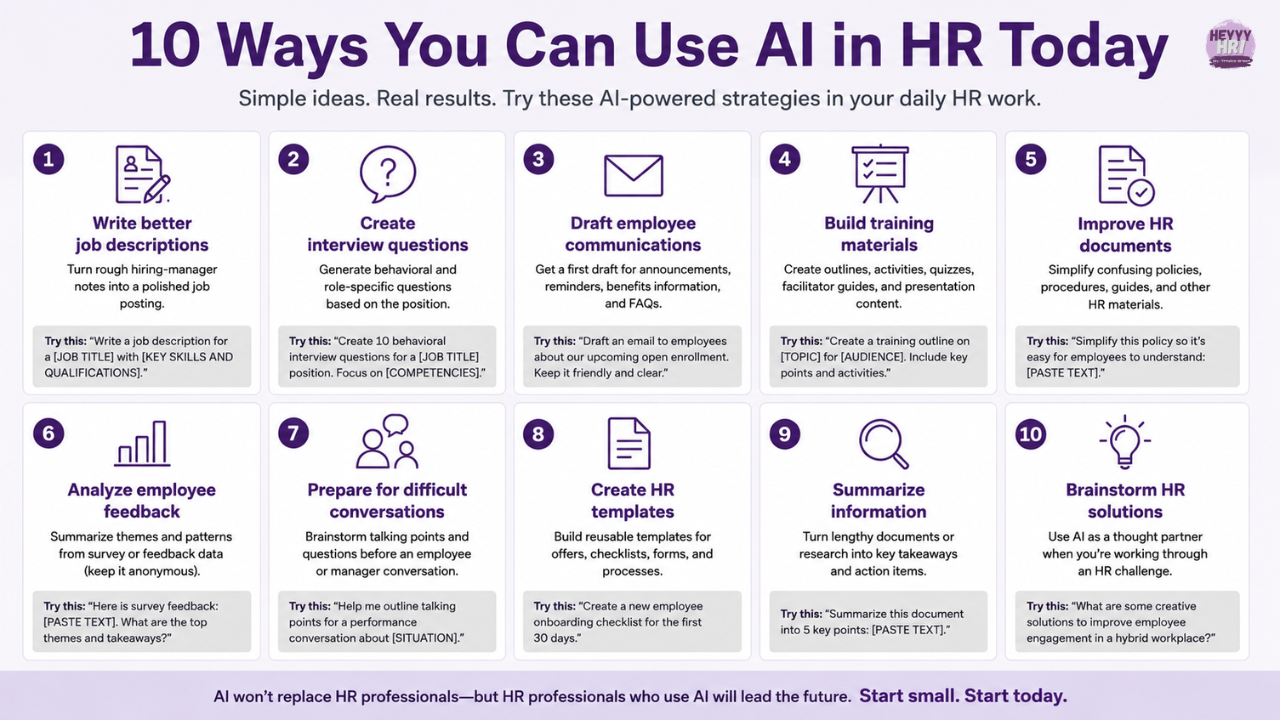
Administrative and repetitive work like scheduling, creating first drafts, summarizing information, answering routine questions, and managing workflows can be great opportunities for automation. These are tasks where AI can give HR professionals valuable time back.
But decisions and conversations involving an employee’s career, compensation, performance, wellbeing, employment status, or workplace relationships deserve human involvement.
A simple rule to remember:
Automate the task. Keep the judgment human.
Use the guide below to help you decide where AI and automation can make HR more efficient—and where the human side of HR still needs to lead.
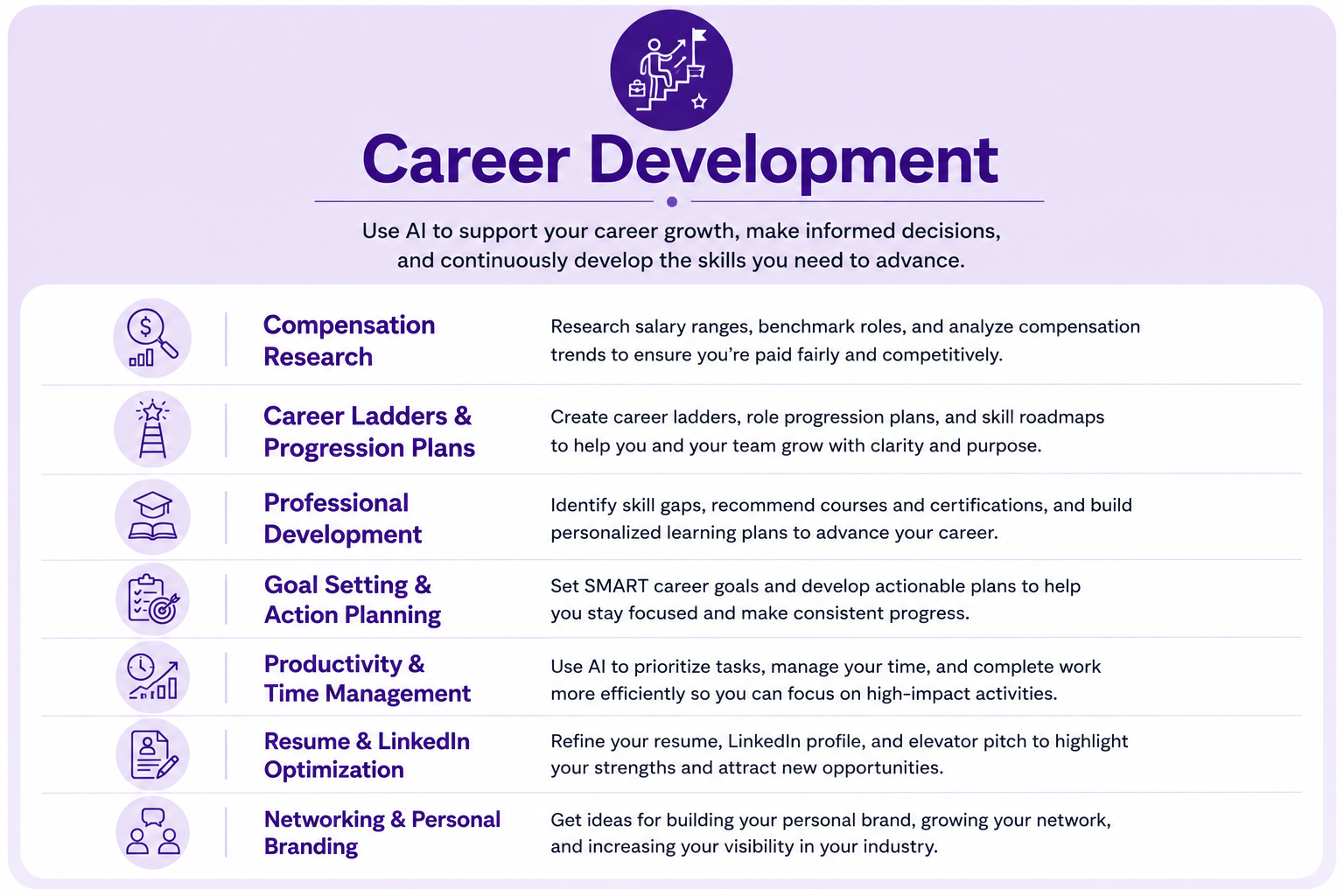
What Can AI Actually Help You Do in HR?
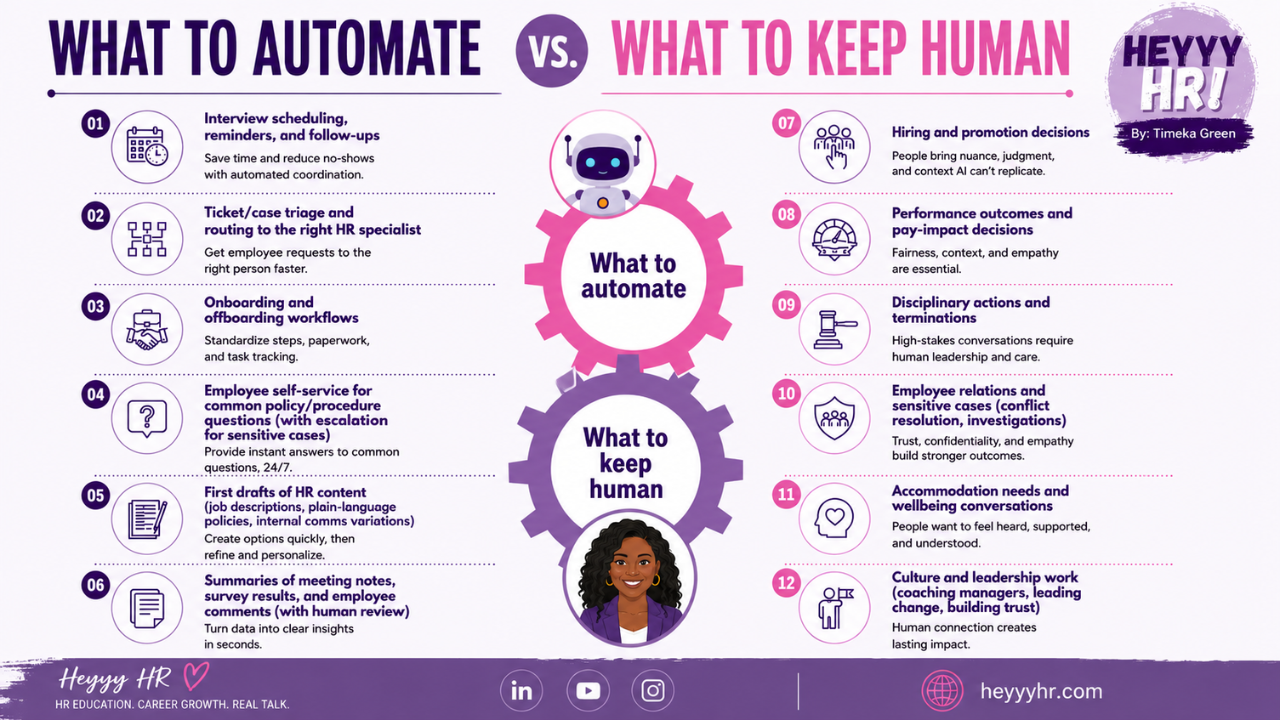
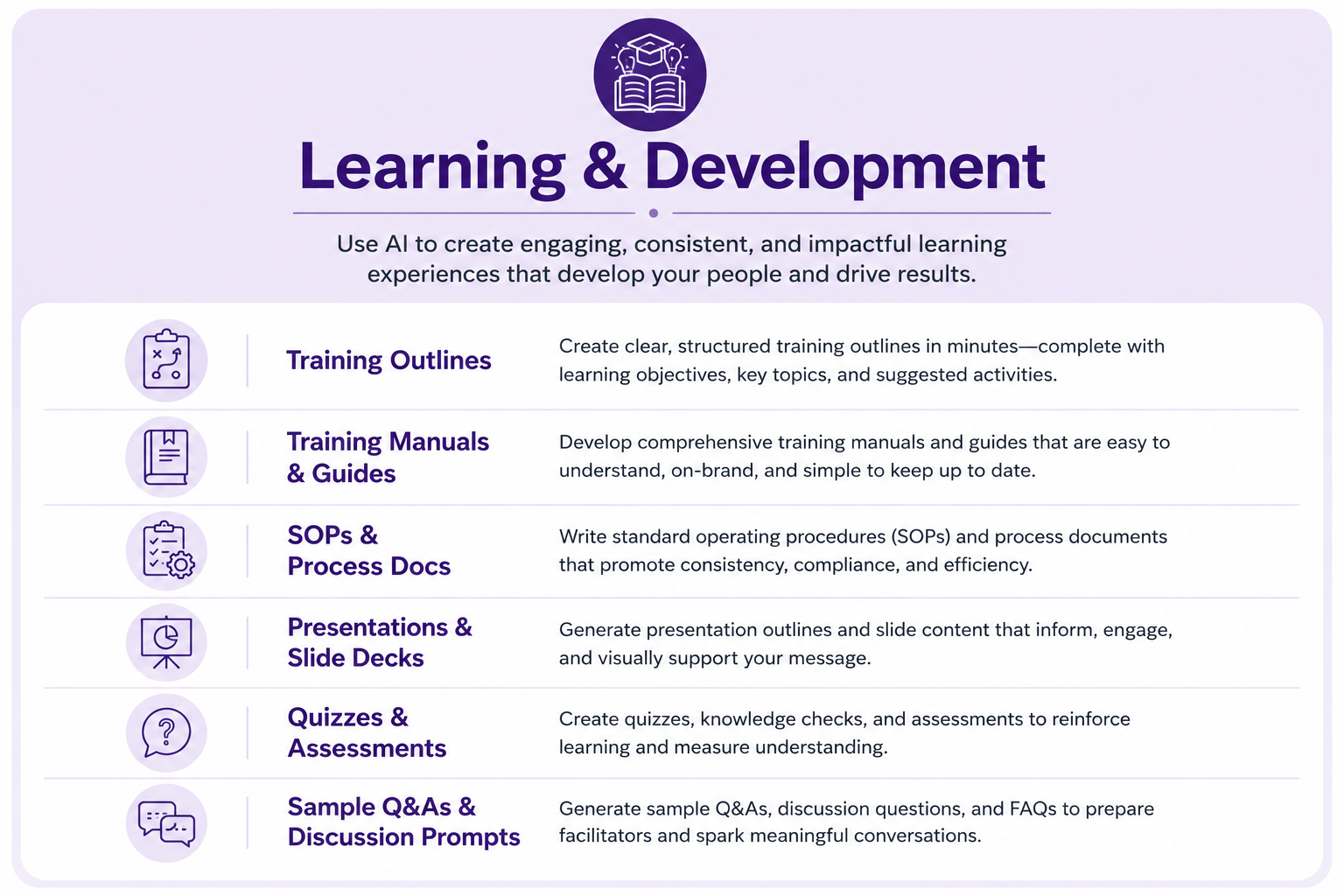
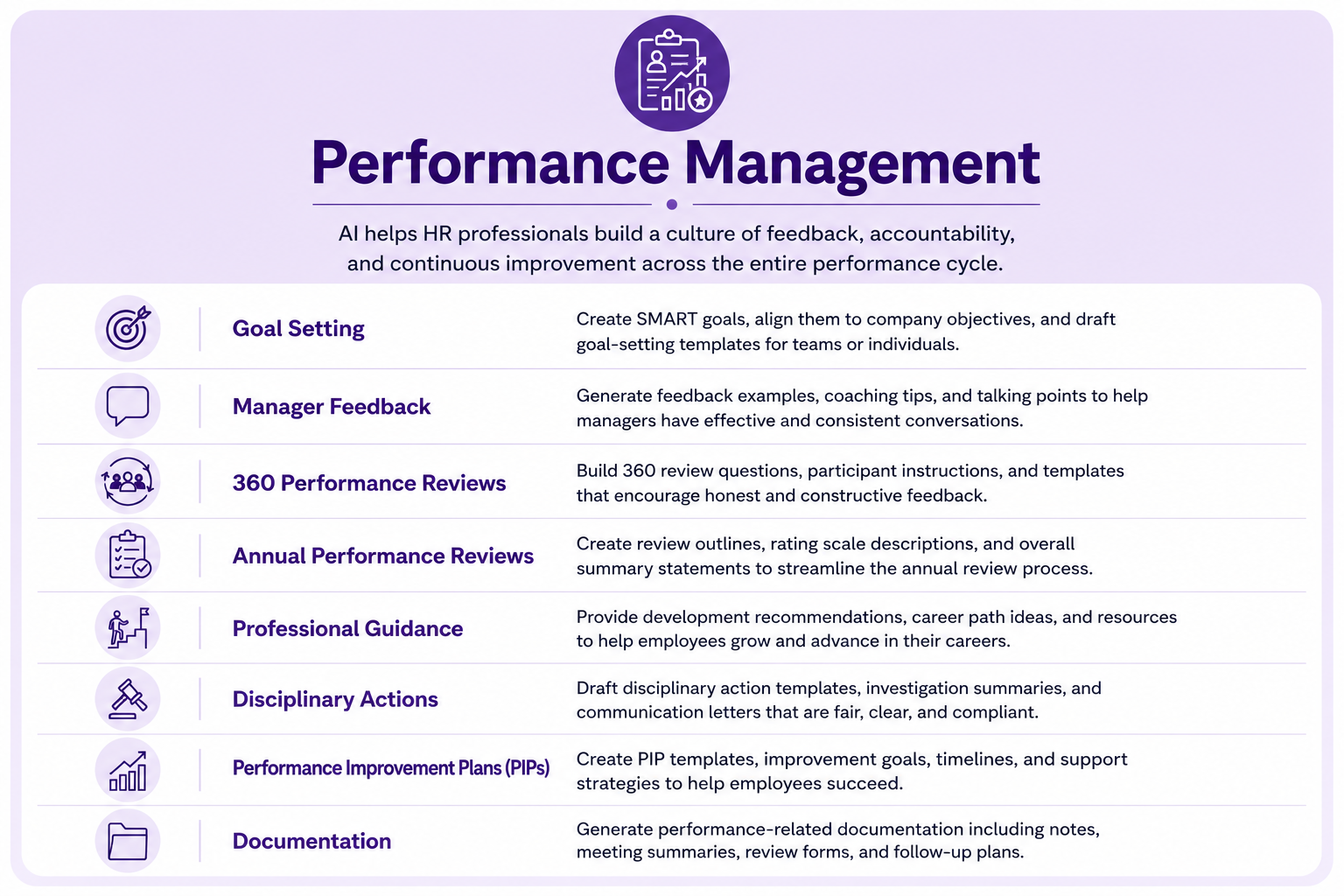
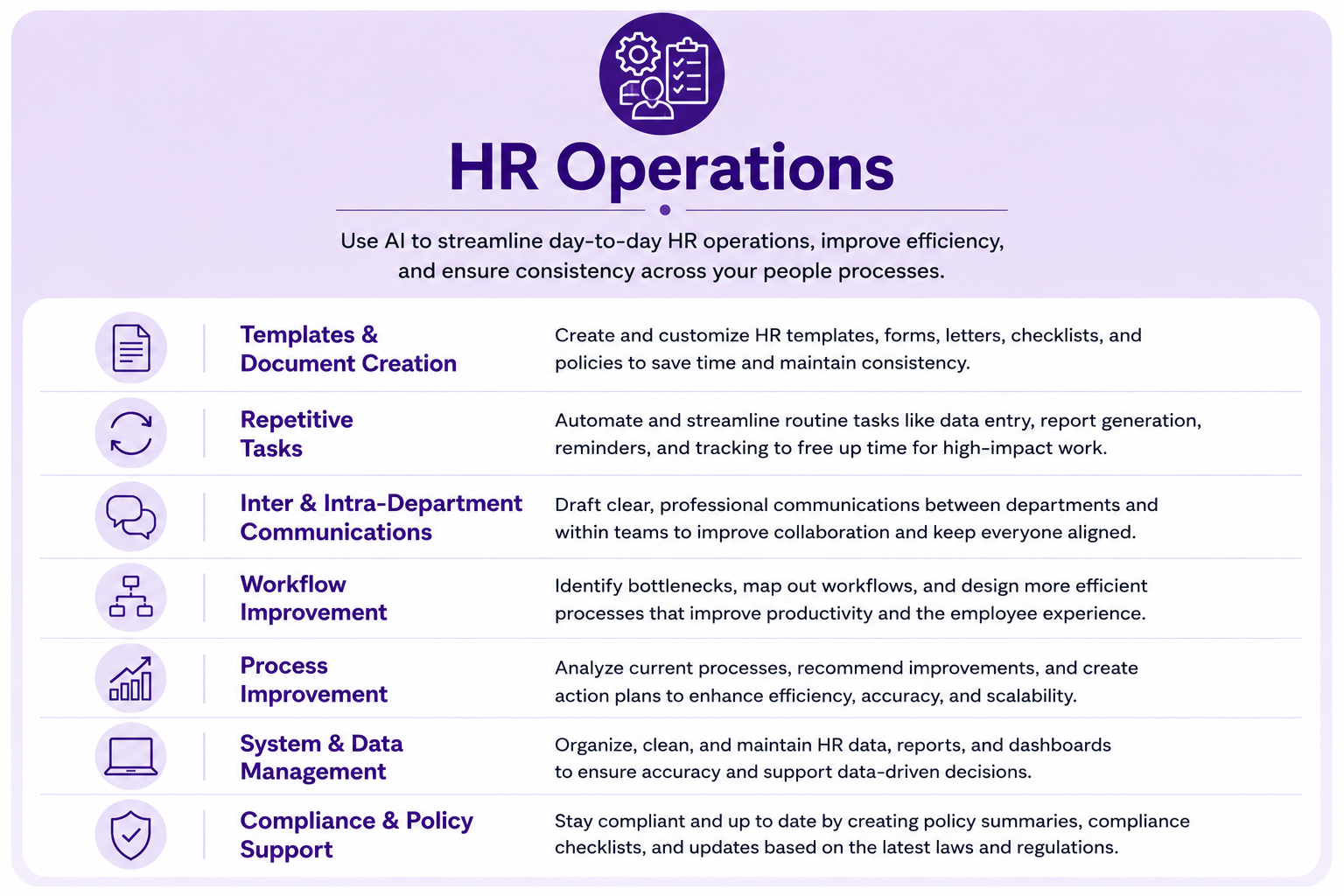
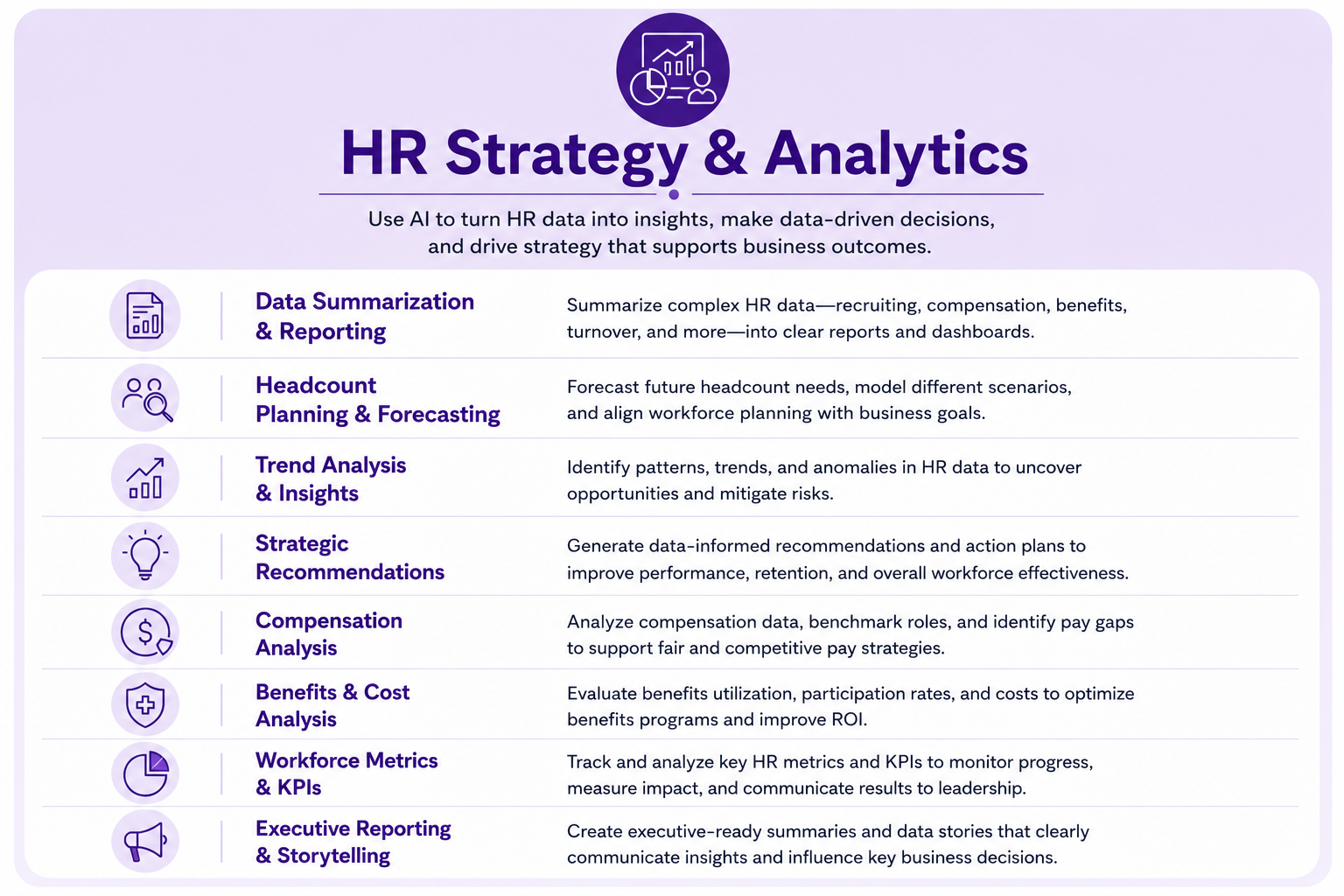
AI isn’t limited to writing emails or creating job descriptions. When used effectively, it can support HR professionals across nearly every stage of the employee lifecycle—from recruiting and onboarding to performance management, learning and development, HR operations, workforce strategy, and even your own career development.
The key is knowing where AI can add value to the work you’re already doing.
Think of AI as a thought partner and productivity tool. It can help you create first drafts, organize information, analyze data, identify trends, brainstorm solutions, improve processes, and complete time-consuming tasks more efficiently—while you provide the HR expertise, context, and judgment.
Explore the HR functions below for practical examples of how you can put AI to work in your everyday HR responsibilities.
Free AI in HR Resources
Learn AI. Apply It to HR. Keep Building Your Skills.
AI is evolving quickly, and you don’t have to figure it all out on your own. The Heyyy HR AI in HR Resource Library is designed to help HR professionals understand what’s changing, learn how to use AI more effectively, and find practical ways to apply it to real HR work.
Explore articles covering topics like ChatGPT for HR, AI tools, prompting, recruiting, productivity, responsible AI use, and the future of HR in an AI-powered workplace.
Whether you’re wondering where to start, which AI tools are actually worth learning, or how AI could impact your HR career, these free resources will help you continue building your knowledge and confidence.
Start with a topic that interests you, try what you learn, and come back as your AI skills grow.
Watch & Learn: AI in HR Videos
See How AI Can Work for You
Sometimes the easiest way to learn AI is to see it in action. Explore free videos designed to help HR professionals understand AI tools, discover practical ways to use them at work, and keep up with how artificial intelligence is changing HR and the workplace.
Whether you’re learning the differences between tools like ChatGPT, Claude, and Gamma, exploring how recruiters are using AI, or looking for ways to use AI to advance your own career, these videos break the technology down into practical, easy-to-understand lessons.
No technical background required.
Start with the topic that interests you most, experiment with what you learn, and build your AI skills one step at a time.
Want to keep learning? Explore the full AI playlist for more tutorials, tools, tips, and practical ways to use AI at work.

AI in HR Starter Kit:
Tools, Learning Path & Practical Strategy
Knowing that AI exists isn’t the same as knowing how to use it effectively.
These resources will help you move from experimenting with AI to using it intentionally in your HR work.
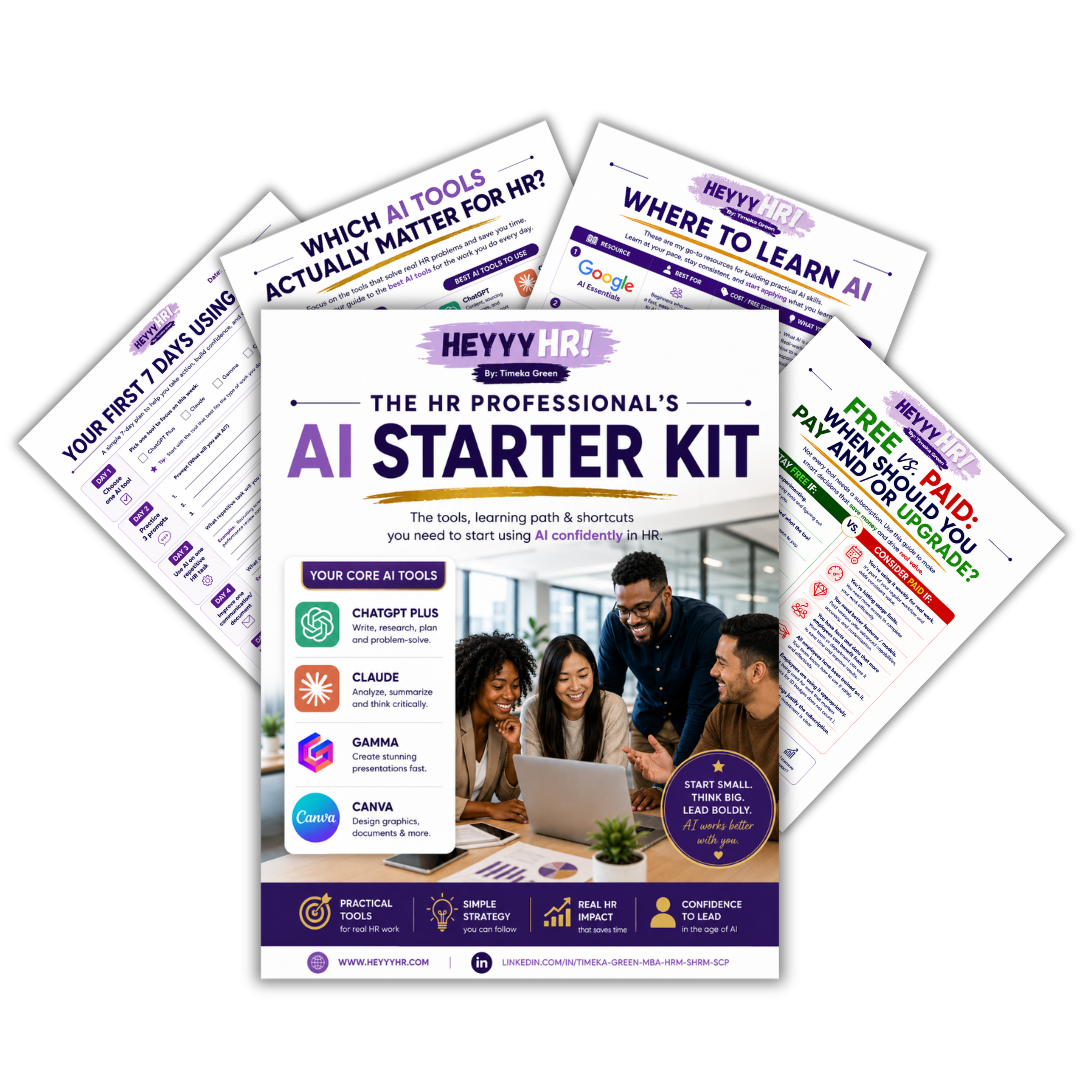
AI is changing HR, but you don’t need to learn every tool or become an AI expert to keep up.
The AI in HR Starter Kit gives HR professionals a practical roadmap for using AI with confidence. Learn which tools are actually worth your time, when free versions are enough, when it makes sense to upgrade, where to learn AI skills, and how to begin incorporating AI into your everyday HR work.
Regular Price $17
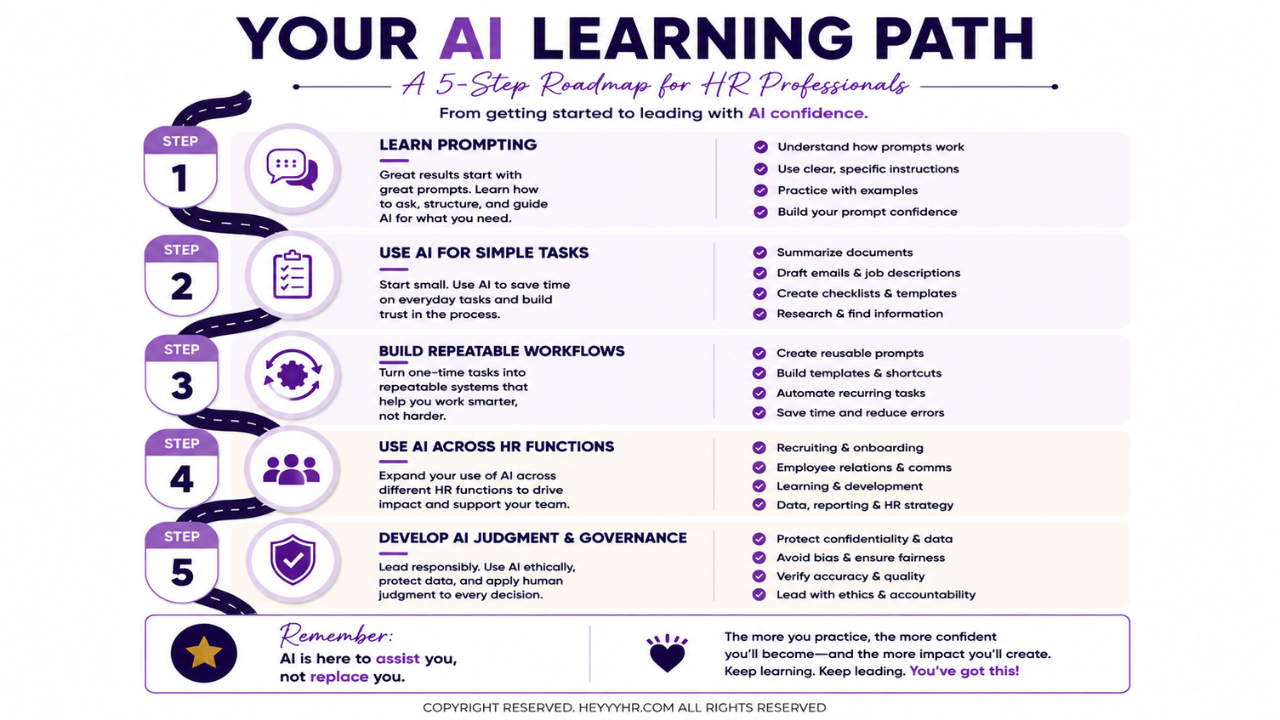
Your AI Learning Path
You Don't Have to Learn Everything at Once
One of the biggest mistakes you can make when learning AI is trying to learn every tool, every feature, and every new trend at the same time. You don’t need to.
Building your AI skills is a progression.
Start by learning how to communicate effectively with AI through prompting. Then use it for simple, everyday tasks that save you time. As you become more comfortable, you can create repeatable workflows, expand AI into different areas of HR, and eventually develop the judgment needed to use AI strategically and responsibly.
The goal isn’t to become an AI expert overnight. It’s to become an HR professional who knows how and when to use AI effectively.
Use this 5-step roadmap as your guide. Start wherever you are today and continue building from there.
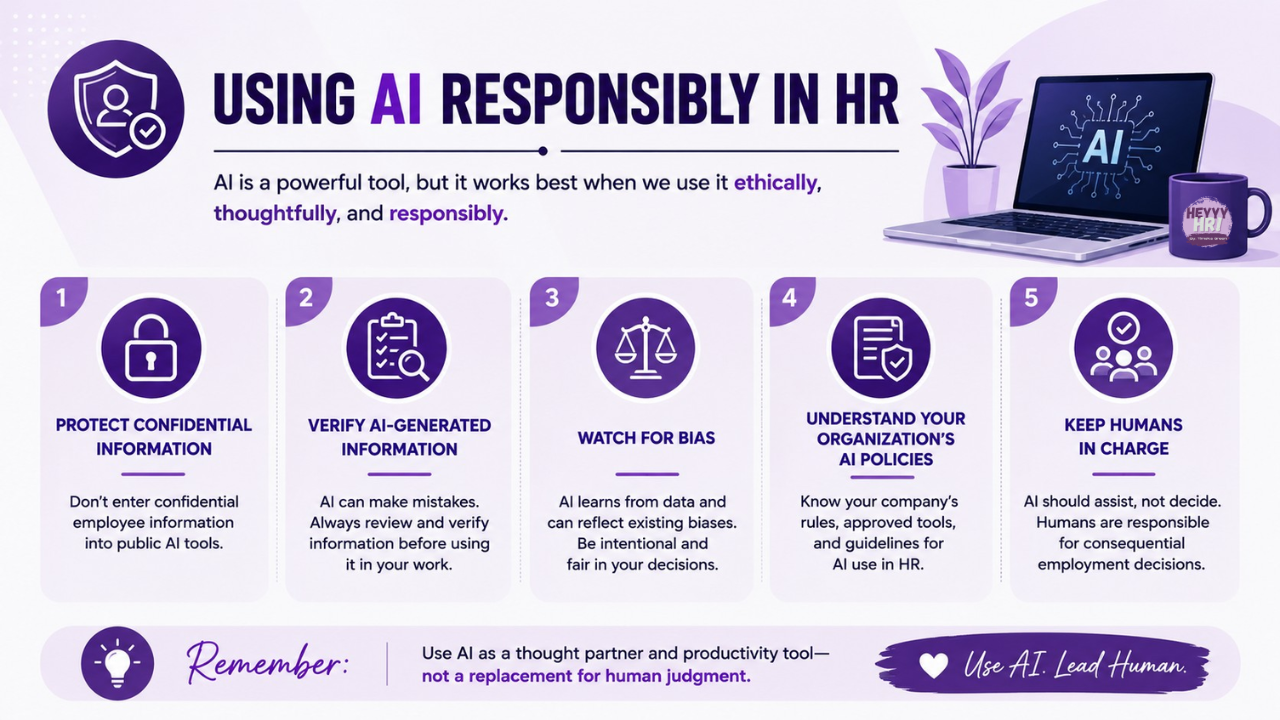
Using AI Responsibly in HR
AI Can Help You Work Smarter—But You're Still Responsible for the Work
AI can save time, generate ideas, analyze information, and help HR professionals work more efficiently. But working faster doesn’t eliminate our responsibility to protect employees, make fair decisions, and use good judgment.
HR professionals regularly work with confidential information and make decisions that can significantly affect someone’s employment, compensation, career, and livelihood. That means we have to be especially thoughtful about what information we give AI, how we use its output, and which decisions should remain human.
AI can assist with the work, but it shouldn’t become the final decision-maker.
Before incorporating AI into your everyday HR practices, keep these five principles in mind.
Frequently Asked Questions
What is AI in HR?
AI in HR refers to using artificial intelligence to support Human Resources tasks, processes, analysis, and decision-making. HR professionals can use AI to help with recruiting, employee communications, learning and development, performance management, HR operations, data analysis, workforce planning, and much more.
The goal isn’t to remove people from Human Resources. It’s to use technology to handle some of the repetitive, time-consuming work so HR professionals have more time for the work that requires strategy, relationships, empathy, and human judgment.
Want to understand the basics? Read my What Is AI? article or watch What Is AI? ChatGPT, Claude & Gamma Explained for Beginners.
What are the best AI tools for HR professionals?
There isn’t one AI tool that every HR professional needs. The best tool depends on what you’re trying to accomplish.
General-purpose tools such as ChatGPT and Claude can help with writing, brainstorming, research, analysis, and problem-solving. Tools such as Gamma can help you quickly turn ideas and information into presentations, while AI features built into other workplace platforms can help automate specific parts of your workflow.
Instead of trying to learn every AI tool available, focus on a few tools that solve problems you actually have.
Not sure where to start? Use my AI in HR Starter Kit to learn which tools are worth your time and which ones you can skip.
How can HR professionals use ChatGPT for work?
HR professionals can use ChatGPT as a thought partner, writing assistant, research tool, and productivity tool.
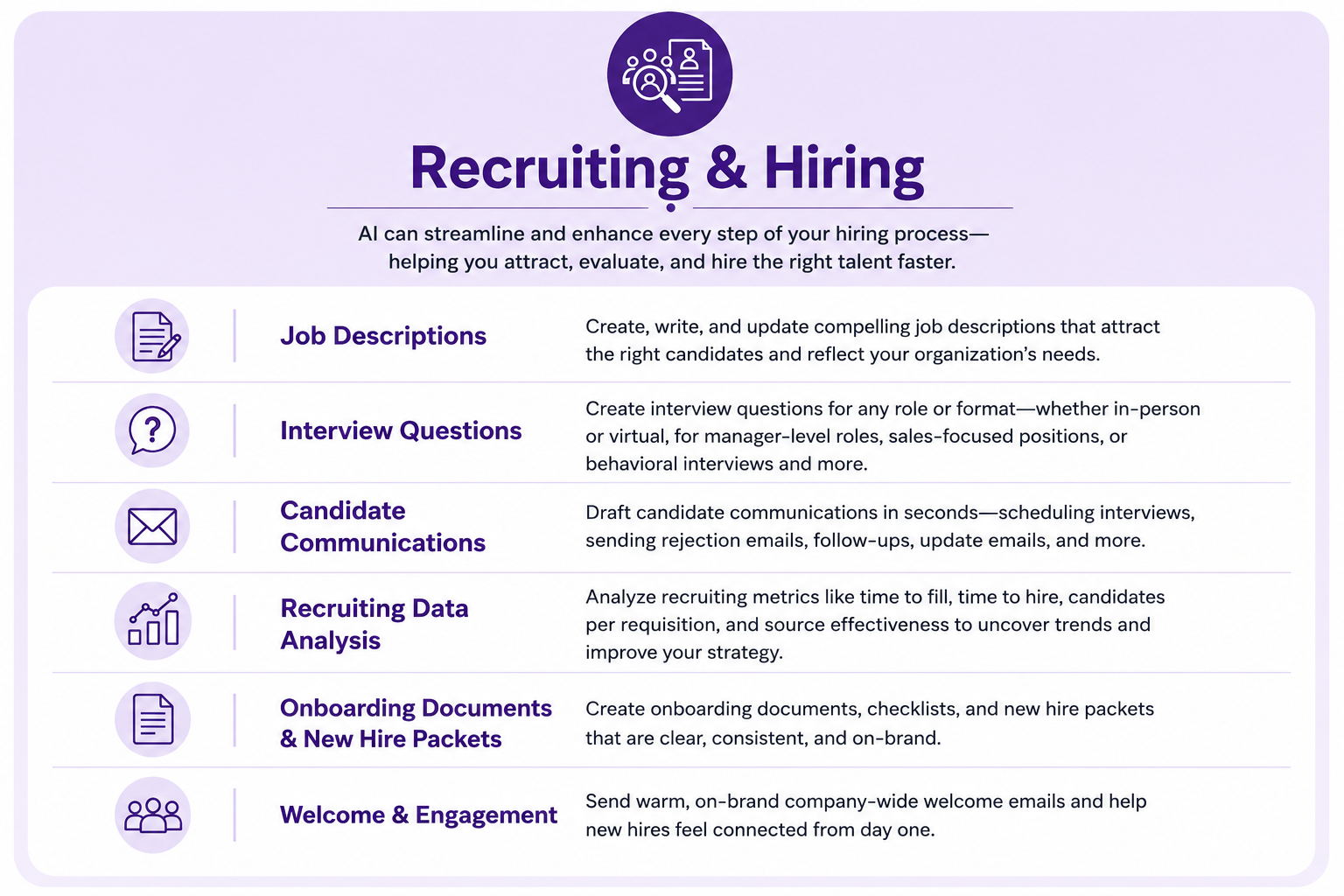
For example, ChatGPT can help you draft job descriptions, create interview questions, develop training materials, brainstorm employee communications, summarize non-confidential information, build templates, create SOPs, analyze appropriately prepared data, develop presentation outlines, and improve HR workflows.
The quality of the result, however, depends heavily on the instructions you give it. Learning how to write effective prompts is one of the best places to start.
Want to try it yourself? Download my free ChatGPT Prompts for HR Professionals and start practicing with prompts created around real HR responsibilities.
Can AI replace HR professionals?
AI will change HR jobs, but that doesn’t mean every HR professional is going to be replaced by artificial intelligence.
AI is particularly good at helping with repetitive tasks, first drafts, information organization, summarization, pattern identification, and administrative work.
HR professionals are still needed for work involving employee relationships, organizational context, leadership, strategy, investigations, difficult conversations, culture, ethics, and consequential employment decisions.
The bigger career risk may be ignoring AI altogether. As organizations adopt more AI, HR professionals who understand how to combine HR expertise with AI capabilities will be better positioned to contribute in an AI-enabled workplace.
Explore my AI in HR videos and articles to learn how the profession is changing and what you can do to prepare.
Do HR professionals need technical skills to use AI?
No. You don’t need to know how to code or become a data scientist to start using AI in HR.
Start with the skills that are most relevant to the work you already do: writing effective prompts, evaluating AI-generated information, identifying tasks AI can assist with, and understanding when human judgment needs to take over.
As your confidence grows, you can move into more advanced areas such as repeatable workflows, data analysis, automation, and AI governance.
Use the 5-Step AI Learning Path above to see how I recommend progressing from beginner AI use to more strategic applications.
Is it safe to use AI with employee information?
You should be extremely careful about entering employee or company information into AI tools.
Don’t paste confidential, personally identifiable, proprietary, medical, compensation, employee-relations, investigation, or other sensitive information into a public AI tool unless your organization has specifically approved the tool and the use of that information.
You should also understand your company’s AI, privacy, data-security, and technology policies before using AI for work.
When possible, remove identifying information and work with anonymized or appropriately prepared data. And always review AI-generated output before using it.
Start with the “Using AI Responsibly in HR” guide above for five principles every HR professional should understand before incorporating AI into their work.
How can I learn AI for HR?
Start small.
You don’t need to sign up for five courses or learn ten different AI platforms at once. Choose one AI tool, learn the basics of prompting, and start using it for simple, low-risk HR tasks.
Then build from there:
Learn prompting → Use AI for simple tasks → Build repeatable workflows → Use AI across HR functions → Develop AI judgment and governance.
You can start learning right here on Heyyy HR with my free AI in HR articles, YouTube videos, AI resources, and ChatGPT prompts.
And when you’re ready for more structure, explore the AI in HR Starter Kit for my recommended tools, learning resources, practical roadmap, and guidance on what HR professionals should—and shouldn’t—spend their time learning.
Start free. Practice what you learn. Then build your skills as your confidence grows.