Compare Coursera vs Udemy, and you’ll see that both provide very flexible options to learn new skills, learn on the go, and to become a better professional. Coursera and Udemy were once competitors in the online learning space, but that changed in early 2026. The two companies completed their merger in May 2026, creating one of the world’s largest online learning platforms with over 290 million learners and $1.5 billion in combined revenue. This deal brings together Coursera’s focus on university partnerships and professional certificates with Udemy’s marketplace of instructor-led courses.

The merger affects how you access online education. Instead of choosing between two separate platforms, you now have access to a combined catalog of courses. The new company plans to use AI tools to help you find the right skills for your career goals.
This combination changes the online learning market and removes the decision-making of which platform is better for your learning needs. You need to understand what this merger means for course pricing, content quality, and your learning options going forward.
Key Outcomes and Strategic Rationale
The Coursera-Udemy merger creates a combined platform with 290 million learners and $1.5 billion in combined 2025 revenue. This combination brings together complementary business models to build a more comprehensive skills development ecosystem.
Vision for a Unified Skills Platform
The merged company aims to create one of the world’s most comprehensive skills platforms by combining Udemy’s marketplace model with Coursera’s university and industry partnerships. You’ll have access to a broader range of learning options, from Udemy’s diverse instructor-led courses to Coursera’s professional certificates and specializations from top universities.
The platform will leverage skills intelligence across both ecosystems to help you discover, develop, and master in-demand skills. This unified approach means you can access content that ranges from practical job skills to credential-bearing programs, all in one place.
The combination strengthens the value proposition for both learners and organizations. You benefit from expanded course catalogs and improved pathways between different types of learning content.
AI-Driven Product Innovation
Both companies are investing heavily in AI-powered learning experiences. The merged platform plans to deliver adaptive, personalized learning that adjusts to your skill level and learning pace.
You’ll see AI tools that help identify skill gaps, recommend relevant courses, and validate your competencies for the workplace. The combined technology infrastructure allows for faster development of these AI features than either company could achieve independently.
The focus on AI-driven innovation addresses the growing demand for reskilling in response to rapid technological change. Your learning experience will become more dynamic and responsive to market needs.
Cost Synergies and Financial Advantages
The merger is expected to generate cost synergies through operational efficiencies. By combining technology platforms, administrative functions, and operational infrastructure, the company can reduce duplicate expenses while maintaining service quality.
The improved financial profile strengthens the combined company’s ability to invest in product development and market expansion. You can expect continued platform improvements funded by these operational savings.
The deal structure, as an all-stock transaction valued at approximately $2.5 billion, creates a stronger market position for the combined entity. This financial stability supports long-term platform development and the companies’ shared mission as mission-driven organizations focused on workforce development.
Impact on Learners, Instructors, and Enterprise Customers
The merger creates a combined ecosystem of 290 million learners and 18,000 enterprise customers, fundamentally changing how you access courses, earn credentials, and develop professional skills through a unified online learning platform.
Expanded Access to Courses and Credentials
You now have access to a broader range of learning options that combine Udemy’s practical skills courses with Coursera’s university-branded programs and professional certificates. The combined platform offers you more flexibility in how you learn and validate your skills.
If you’re focused on career advancement, you can choose between quick professional skills courses and comprehensive degree programs from the same platform. The merger brings together Coursera’s academic credentials with Udemy’s hands-on technical training in areas like software development, data science, and business skills.
You gain access to both platforms’ content libraries without switching between different services. This means you can build complete skills tracks that combine theoretical knowledge with practical application, making it easier to upskill and reskill for new career opportunities.
Enterprise Solutions and Workforce Development
Your organization now has access to a unified platform combining professional skills training with accredited learning programs. The merger brings together Udemy Business and Coursera for Business into a more comprehensive workforce development solution.
Enterprise customers can build complete reskilling programs that include both quick-turnaround skills courses and longer-term professional development paths. You can deploy AI-powered learning recommendations that match employee skill gaps with relevant training content from both platforms.
The combined platform serves 18,000 enterprise customers with enhanced tools for tracking employee progress and measuring training ROI. You get access to skills assessments, AI role plays, and labs alongside traditional course content, making it easier to prepare your workforce for changing job requirements.
Udemy Stock and Coursera Stock
The merged Coursera-Udemy entity operates under Coursera’s existing leadership structure and public benefit framework. The company maintains its stock listing and has introduced a share repurchase program while serving over 290 million learners globally.
Executive Team and Board Structure
Coursera retained its leadership team following the merger completion on May 11, 2026. The company operates as a Public Benefit Corporation, maintaining its commitment to social impact alongside profit.
The board of directors was reconstituted after the merger closed. While Coursera’s leadership structure remained in place, the combined entity now oversees a much larger operation with $1.5 billion in combined 2025 revenue.
Andrew Ng continues his involvement with Coursera as a co-founder. The executive team focuses on integrating operations from both platforms while pursuing cost and technology synergies.
Coursera Stock and Shareholder Initiatives
You can trade Coursera stock on public markets following the all-stock merger transaction. Udemy delisted as part of the combination, with each Udemy share converting to 0.800 shares of Coursera common stock.
Coursera stockholders approved the merger on April 9, 2026, alongside Udemy shareholders. The transaction valued the combined company at approximately $2.5 billion.
The company launched a share repurchase program to reinforce long-term value for investors. This initiative demonstrates management’s confidence in the merged entity’s future growth prospects.
Ongoing Commitments to Mission and Scale
The merged platform serves 290 million learners worldwide, creating one of the largest online learning ecosystems. You gain access to expanded course offerings across both the original Coursera and Udemy catalogs.
Coursera maintains its Public Benefit Corporation status after the merger. This legal structure requires the company to balance shareholder interests with broader social impact goals.
The combined entity focuses on AI-powered skills development and adaptive learning technologies. Your learning experience will increasingly incorporate these innovations as the platform integration progresses through 2026 and beyond.
Key Takeaways
- Coursera and Udemy merged in May 2026 to form a single platform serving 290 million learners worldwide
- The combined company offers access to both course catalogs and plans to integrate AI-powered learning tools
- The merger creates new opportunities for learners while reshaping the online education industry
Frequently Asked Questions
Coursera and Udemy completed their merger in May 2026, but many learners still have questions about how the platforms compare and what the combination means for their learning experience. The platforms remain separate for now, with different approaches to pricing, credentials, and course quality.
Which platform is better for career advancement, such as job-ready certificates and employer recognition?
Coursera offers stronger credentials for career advancement through partnerships with universities and major companies. You can earn accredited degrees, professional certificates, and credentials that employers widely recognize.
Udemy focuses more on practical skills training. The platform offers completion certificates, but these carry less weight with employers compared to Coursera’s academic partnerships.
For job-ready programs, Coursera provides Google Career Certificates and similar programs designed specifically for employment. These programs often include hands-on projects and industry-recognized credentials that you can add to your resume.
What are the main differences in course quality, structure, and credentials between the two platforms?
Coursera partners with universities and established institutions to create structured courses. You get graded assignments, peer reviews, and a consistent learning experience across different courses.
Udemy allows anyone to create and sell courses. This means course quality varies significantly from instructor to instructor. Some courses are excellent while others may lack depth or proper structure.
Coursera courses follow academic schedules with set deadlines and structured syllabi. Udemy courses let you learn at your own pace without deadlines or required assignments.
The credentials differ substantially. Coursera offers verified certificates, professional certificates, and even master’s degrees. Udemy provides basic completion certificates that show you have finished the course.
How do pricing and subscription options compare, including refunds and lifetime access policies?
Coursera uses a subscription model for most content. You pay monthly to access courses, typically between $39 to $79 per month, depending on the program. Individual courses can also be purchased separately.
Udemy sells individual courses at one-time prices. Course prices range from $10 to $200, though sales frequently drop prices to $10-20. You get lifetime access to any course you purchase.
Coursera offers a 7-day free trial for most subscriptions. You can get refunds within 14 days of payment if you haven’t earned a course certificate.
Udemy provides a 30-day money-back guarantee on all course purchases. This gives you more time to decide if the course meets your needs.
Has there been any confirmed acquisition or merger announcement between the two companies, and when would it take effect?
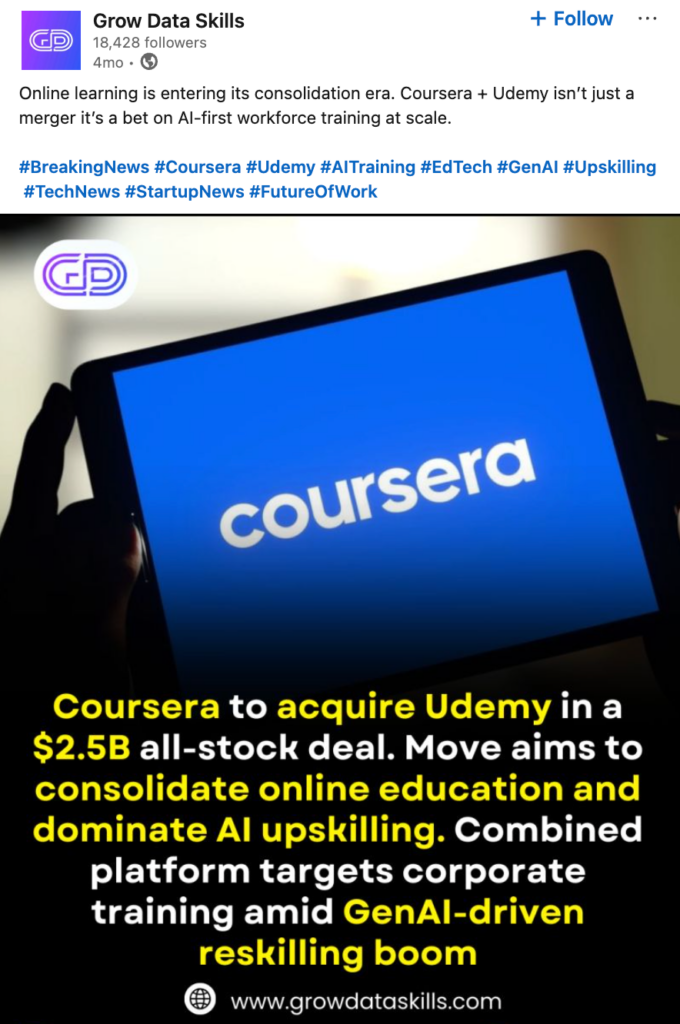
Coursera and Udemy announced their merger on December 17, 2025. The deal was valued at approximately $2.5 billion.
Shareholders from both companies approved the merger on April 9, 2026. The transaction was officially completed on May 11, 2026.
Under the merger terms, each Udemy share was exchanged for 0.800 shares of Coursera common stock. This created a combined company serving more than 290 million learners worldwide.
If a merger were to occur, what would happen to existing purchased courses, certificates, and user accounts?
The merger is now complete, but both platforms remain separate for the time being. Your courses, certificates, and accounts stay exactly as they were before the merger.
You can still access all your purchased Udemy courses with lifetime access as promised. Your Coursera subscriptions and completed certificates remain valid and unchanged.
The companies plan to eventually provide access to more courses and introduce AI-powered learning features. They will announce any changes to user experiences before implementing them.
Your existing credentials and certificates keep their value. Both platforms continue to operate independently while the companies work on long-term integration plans.
You will also like…
- Coursera
- Chat GPT and AI
- Human Resources Using AI like ChatGPT: Enhancing Recruitment and Operations
- HR Courses Online: Enhancing Human Resources Skills for Professionals

 Subscribe to my channel